Window Tint Laws UAE can be confusing when a shop’s shade label, a film’s technical specification and advice from other drivers use different percentages. Before choosing a film, understand which windows may be covered, what the stated percentage means and which penalties apply.
This guide explains seven practical checks for drivers considering tinting in Dubai and elsewhere in the UAE. It separates published rules from product claims, with links to official sources so you can check the requirements for your vehicle.
Sources checked: 15 October 2026. This is general information for car owners. Confirm any vehicle-specific restriction or permit with the relevant traffic authority before installation.
Quick answer: Published UAE guidance allows up to 50% car-window tinting, excluding the front windscreen. The Dubai Police road-safety portal lists an AED 1,500 fine for exceeding the permitted tint level. Dubai also has separate impoundment provisions. See the official sources linked below; do not assume one percentage applies to every vehicle or window.
1. Window Tint Laws UAE: Understand the General Limit
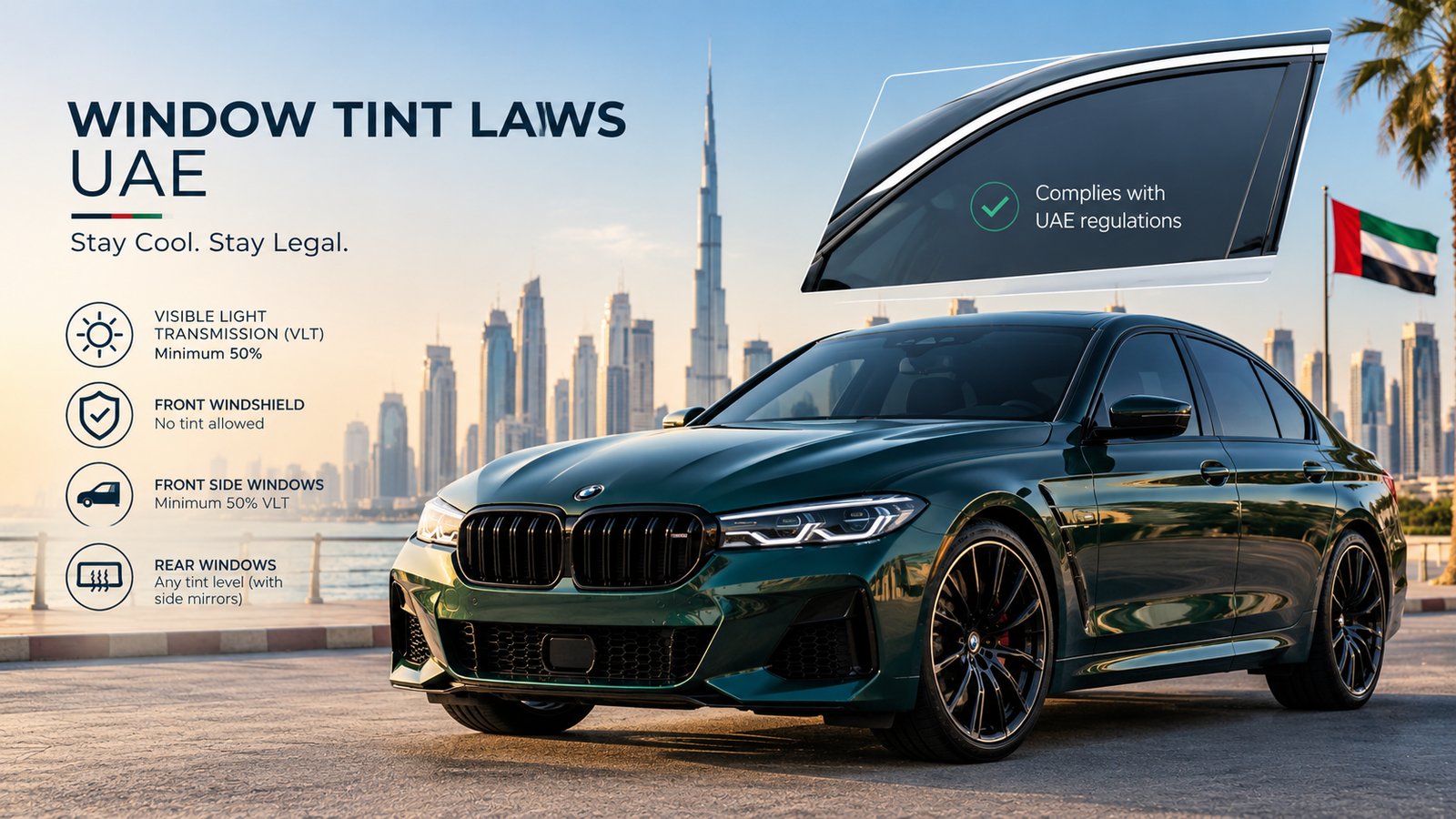
Emirates News Agency’s report on the 2017 traffic-regulation amendments states that car-window tinting is permitted up to 50%, with the front windscreen excluded. This is the basis of the commonly quoted rule for side and rear car windows.
Treat the limit as a starting point for a compliance discussion, rather than simply selecting the darkest sample in a display. Tell the installer what you drive, how it is registered and whether the glass already has factory shading. Ask how the proposed installation will be assessed for that vehicle.
A road-going car also needs usable visibility. Check the view through the side glass, mirrors and rear window in conditions that resemble your normal journeys. Underground parking, dim streets and reversing after sunset can feel very different from a bright workshop.
2. Keep the Front Windscreen Separate
The windscreen is not covered by the ordinary side-window allowance. Dubai’s Decree No. 30 of 2023 specifically includes tinting a windscreen without a permit among mandatory administrative impoundment cases.
Do not assume a product advertised as clear, “zero tint” or heat-rejection film is automatically authorised for the windscreen. A product description is not a permit. Obtain confirmation from the relevant authority before having film fitted there.
Likewise, do not rely on an old online statement about a permitted sun strip without checking the current requirements for your car. Keeping the driver’s forward view clear should guide the decision. Any claimed exception needs a reliable basis, not a verbal promise that other customers have used it.
3. Window Tint Laws UAE: Decode the Percentages
The phrase “50% tint” can be used loosely in conversation. Before comparing prices, ask whether a number describes darkness, visible light transmission or heat rejection. These are different properties.
| Term | What it describes | What to ask |
|---|---|---|
| Visible light transmission (VLT) | The proportion of visible light passing through a material | Is this a film-only figure or a reading through the fitted glass? |
| Shade or darkness label | A seller’s description of appearance | What measured specification supports this label? |
| Heat rejection | Performance against solar energy under stated test conditions | Which test and specification are used? |
| UV rejection | Performance against ultraviolet radiation | What does the product data sheet actually state? |
Lower VLT means less visible light passes through. By contrast, a larger claimed heat-rejection figure does not necessarily mean a darker film. Neither a UV figure nor an infrared figure is proof that the installed window complies with traffic rules.
Factory glass matters because film is applied to an existing material. As a simplified optical example, glass transmitting 80% of visible light combined with film transmitting 70% would transmit approximately 56%: 0.80 × 0.70 = 0.56. That calculation illustrates light transmission; it is not an official legal test or a compliance certificate.
For Window Tint Laws UAE decisions, ask for a clear explanation of the authority’s applicable requirement and the finished installation, rather than translating a shop label into a legal percentage yourself.
4. Check Fines and Dubai Impoundment Costs
The Dubai Police road-safety portal’s penalty table lists AED 1,500 for exceeding the permitted level of tinting and AED 1,500 for tinting a vehicle that is not allowed to be tinted.
Separately, Dubai Decree No. 30 of 2023 lists excessive window tinting or windscreen tinting without a permit as an impoundment ground. Article 4 sets an AED 10,000 release payment for that category. The decree applies without prejudice to other prescribed penalties.
The AED 1,500 traffic fine and Dubai’s AED 10,000 release payment are different amounts with different legal functions. Do not describe the release payment as a single nationwide tint fine. For a specific case, follow the issuing authority’s notice and instructions.
From a practical budgeting perspective, an unsuitable installation may also mean paying for removal and replacement. Keep the invoice and product details, and resolve uncertainty before work starts. A low initial quotation has little value if the chosen film must be removed.
5. Confirm Your Vehicle Category and Any Permission
Window Tint Laws UAE should not be reduced to a blanket promise that every vehicle can use the same film. A privately used passenger car, a transport vehicle and a fleet vehicle may involve different operational requirements or approval conditions.
If the car is rented, leased or company-owned, obtain the owner’s permission before modifying it. That permission addresses the owner relationship; it does not replace traffic-authority approval where required. For specialist vehicles, ask the licensing authority which rules apply to the registration category.
Do not assume an exemption based on nationality, gender, occupation or a health-related reason. If you believe a special permission applies, ask the authority about eligibility and obtain the required approval before installation. Keep any approval available with the vehicle’s records.
6. Choose Heat Performance Without Chasing Darkness
After checking Window Tint Laws UAE, compare suitable films on documented performance and daily usability. “Ceramic,” “premium” and “nano” are product descriptions, not legal approvals or complete performance specifications.
Request the exact manufacturer and film series. Compare visible light transmission, total solar energy rejection where supplied, optical clarity and the written warranty. Check whether quoted figures refer to the same testing conditions; an isolated infrared claim should not be treated as an all-purpose measure of cabin comfort.
Ask to see a sample and assess visibility from inside the car. Think about your regular driving: school runs, motorway journeys, parking ramps or late-night commuting. The most suitable option balances the permitted installation with visibility, comfort and a finish you can maintain.
For a comparison of material options, read our ceramic tint versus regular tint guide. You can also explore WrapEx Car Care’s window-tinting service in Dubai.

7. Window Tint Laws UAE: Use a Before-and-After Checklist
A clear job specification makes the installation easier to evaluate. Before booking, share your vehicle details and identify exactly which windows are included. Ask the workshop to explain its proposed approach before agreeing to a film.
- Identify the glass: Note existing factory shading and any old film that needs removal.
- Confirm the scope: List each window to be treated and keep the windscreen question separate.
- Record the product: Obtain the brand, series, shade specification and written quotation.
- Resolve permissions: Check any authority or vehicle-owner approval before work begins.
- Inspect the finish: Look for lifting edges, damage or visibility problems, and raise concerns promptly.
- Keep the paperwork: Retain the invoice, warranty and any required approval.
- Follow aftercare: Use the installer’s product-specific advice for curing, window operation and cleaning.
If an existing tint makes driving difficult, arrange an assessment rather than adding another layer. Removing old film can require care around rear-window heating elements and other glass features. Discuss that work with the installer instead of assuming replacement is a simple peel-and-stick job.
Window Tint Laws UAE: Frequently Asked Questions
Is 70% tint legal in the UAE?
First establish what “70%” means. A film with 70% VLT transmits more light than one with 20% VLT; a seller using “70%” to describe darkness may mean something entirely different. A product label alone does not establish legality. Ask the authority about the applicable requirement and have the actual installation assessed.
Does ceramic tint make a darker film legal?
No. Film technology does not create an exemption from Window Tint Laws UAE. Compare ceramic products for their documented performance while keeping the legal requirement and visibility checks separate.
Can I rely on a dealer’s tint package?
Ask the dealer to identify the installed product and explain its suitability for your registration category. Keep the invoice. A package name or the fact that a vehicle came with film does not answer every compliance question.
Does passing an inspection guarantee I will never receive a tint fine?
Do not treat an earlier inspection result as permanent permission for later changes. If film has been replaced, layered or altered, seek fresh advice. Follow the relevant authority’s decision for the vehicle’s current condition.
Can I use the same tint when travelling outside the UAE?
Check the destination country’s rules before driving across a border. A suitable installation for use in the UAE should not be assumed to satisfy another country’s requirements.
Where should I verify a disputed rule?
Use the relevant police or vehicle-licensing authority and describe the exact vehicle, window and proposed film. For Dubai, the official legislation and Dubai Police sources linked in this article provide a useful starting point.
Discuss Window Tint Laws UAE Before Booking in Dubai
Bring your vehicle details, current glass condition and driving needs to the discussion. Ask about a documented film specification, visibility and installation scope before choosing a shade.
Contact WrapEx Car Care in Al Quoz Industrial Area 4, Dubai to discuss window-tinting options and request a vehicle-specific quotation. Call +971 55 179 4177. Authority confirmation should settle any unresolved question about permission or vehicle eligibility before installation.
Official Sources for Window Tint Laws UAE
- Emirates News Agency: 2017 traffic-regulation amendments — published explanation of the general tint allowance.
- Dubai Police road-safety portal: rules and penalties — tint-related traffic-fine entries.
- Dubai Legislation Portal: Decree No. 30 of 2023 — Articles 2 and 4 on impoundment and release payments.